Case Study - CAN controlled, distributed micro pneumatic valve banks
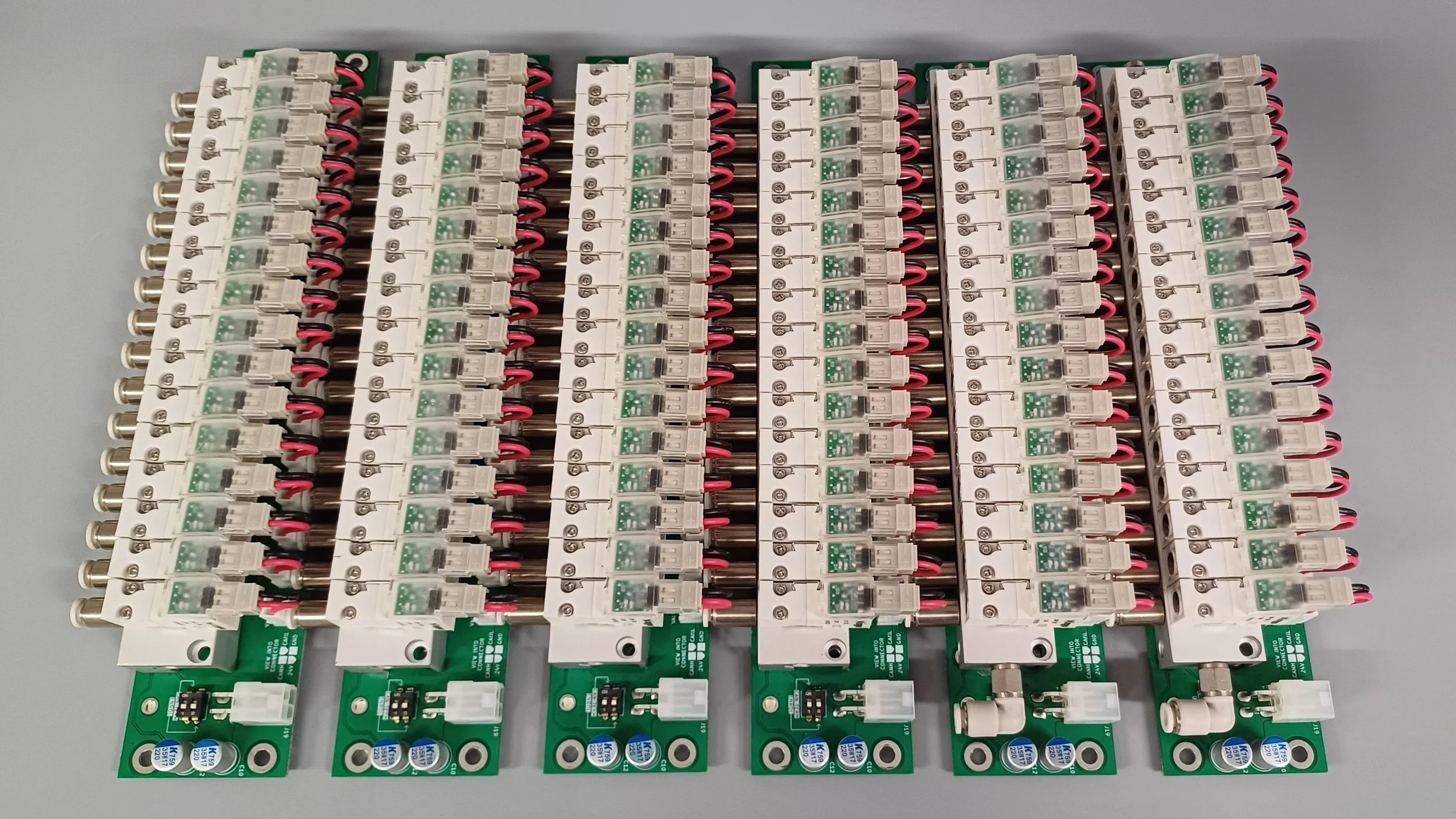
This project involved designing a distributed, CAN-controlled pneumatic valve system to integrate 96 valves into an existing platform with limited I/O capacity. To overcome the constraints of traditional centralised wiring, we developed a valve-on-board architecture, embedding control electronics directly onto each pneumatic block. The result is a modular, addressable system that operates entirely over a shared 4-wire bus (power, ground, and CAN) dramatically reducing wiring complexity, installation time, and cost.
The system demonstrates over 2,000 valve switching events per second, with performance limited only by the physical valve hardware; not by the control electronics or communication protocol. This level of responsiveness enables precise, high-speed control even in complex applications.
We handled the entire solution in-house: hardware design, firmware development, PCB assembly, and mechanical integration. The outcome is a compact, scalable, and highly efficient system that simplifies commissioning while extending the capabilities of the existing host platform.
Thanks to our modular architecture and end-to-end development capability, we can produce custom variants to suit any application, whether that’s different valve counts, alternative communication interfaces such as Ethernet, EtherCAT, or RS-485, or unique mechanical form factors tailored to space or mounting constraints. This flexibility allows us to adapt the core technology to fit seamlessly into new or existing systems, with minimal integration effort.
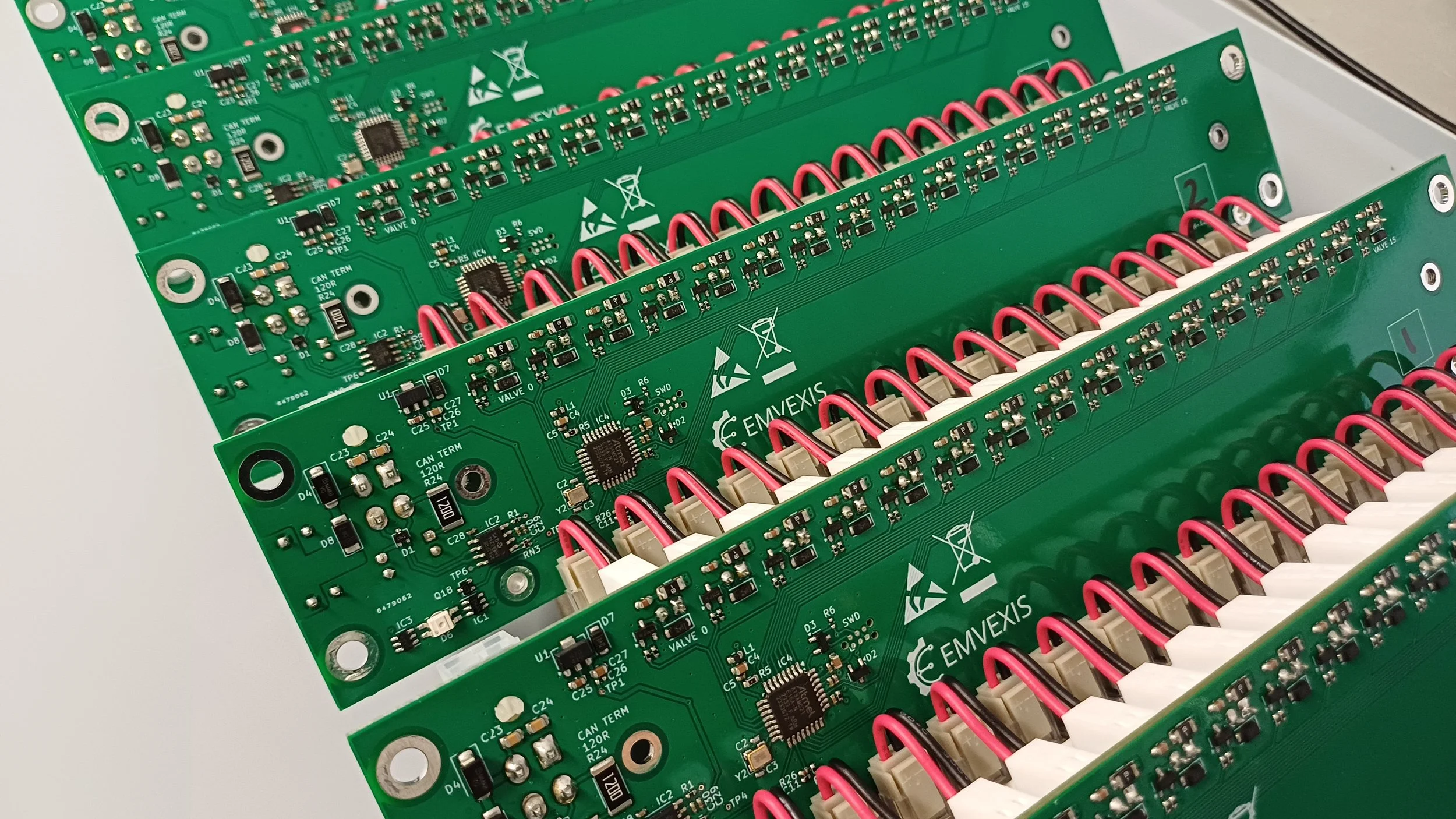
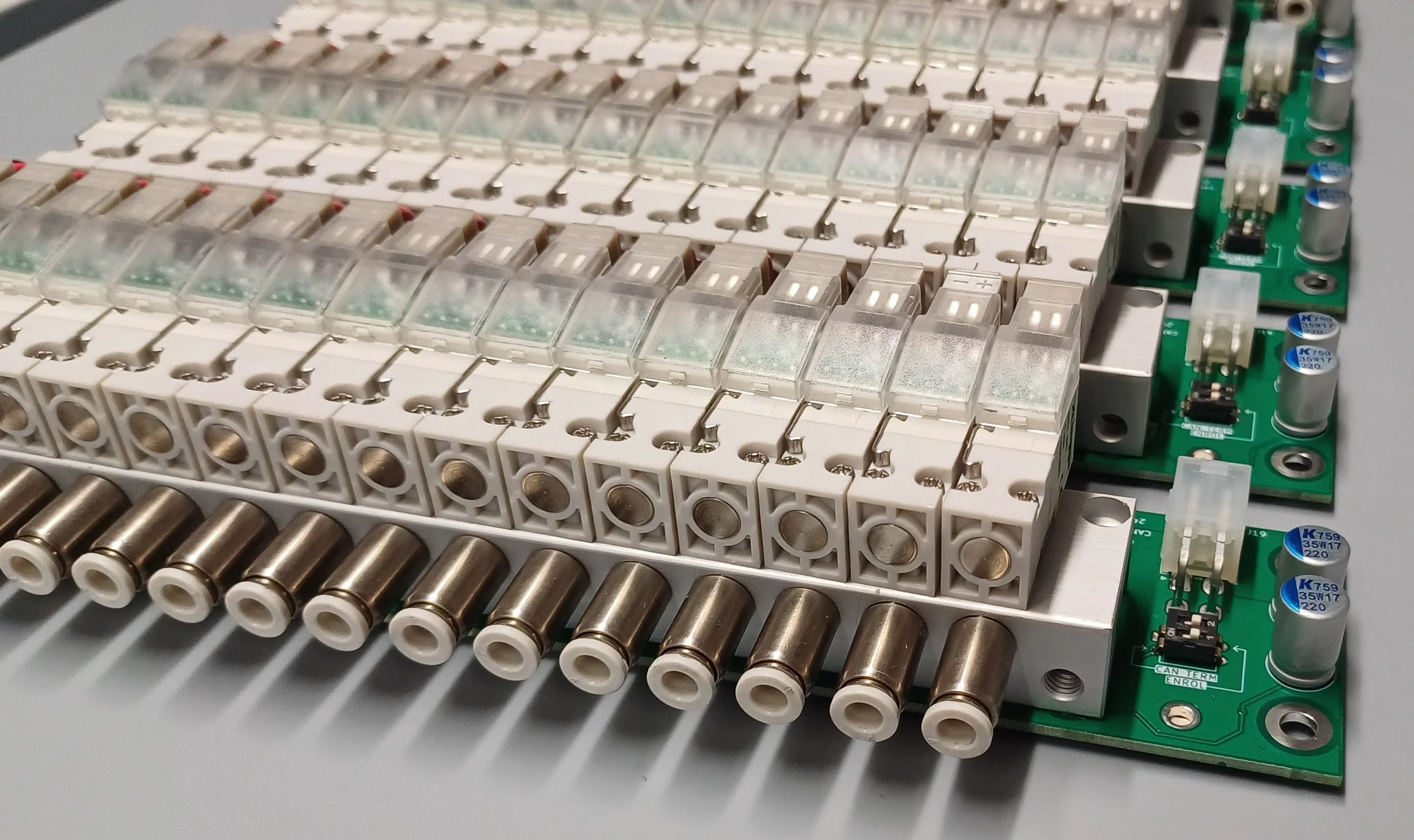
Each valve block supports 16 individually controlled 3/2 normally closed pneumatic valves, with all components operating from a 24V supply (other DC and AC supplies possible). The system supports both CAN 2.0B and CAN-FD protocols, offering flexibility for integration into modern or legacy control architectures.
Every valve is individually addressable over CAN, either at the block level or per-valve, allowing fine-grained control or grouped actuation depending on system requirements. Onboard switchable CAN termination simplifies physical network configuration, especially in systems with multiple branches or removable segments.
Robustness and protection were key design priorities. Each valve channel is individually fused using resettable PTC fuses, offering fault isolation without consumable components. The PCB is protected against reverse polarity, voltage transients, and other common field wiring hazards, ensuring reliable performance in harsh environments.
Typical Applications
This distributed valve system architecture is well-suited to a wide range of industries where compact, scalable, and reliable pneumatic control is required. Typical applications include:
Manufacturing and Industrial Automation
High-speed actuators, part handling, sorting, clamping, or fixturing in production environments.Test and Inspection Systems
Pneumatic actuation for automated test rigs, functional testing, or leak detection equipment.Hydroponics and Environmental Control
Precision control of water, nutrient, and air delivery systems with decentralised valve networks.Packaging and Material Handling
Decentralised pneumatic control for complex, multi-axis systems where wiring minimisation is critical.
With its real-time responsiveness, minimal wiring, and customisability, the system is ideal for any application that requires reliable, high-density pneumatic control with streamlined integration.