Case Study - Industrial test rig controller
In this project, our staff developed a bespoke control system for an industrial hydraulic test rig, designed to automate controlling a wide range of pressure and flow conditions across multiple test profiles. Rather than using a conventional PLC-based solution which would have required multiple add-on I/O modules and still lacked the compute performance needed, a fully custom controller offered better scalability, significantly higher processing capability, and reduced overall cost. This approach allowed us to tailor the hardware and firmware precisely to the application, while avoiding the overhead and limitations of off-the-shelf PLC systems.
The system runs eight high-speed, parallel PID control loops, providing high-resolution regulation of pressure, flow, and force in real time. Advanced calibration features include feed-forward assisted control and an asymmetric gain-scheduling algorithm, allowing accurate response across a wide operating range with minimal overshoot or instability. These software capabilities enable the controller to execute dynamic test sequences while simultaneously performing real-time performance monitoring and pass/fail analysis.
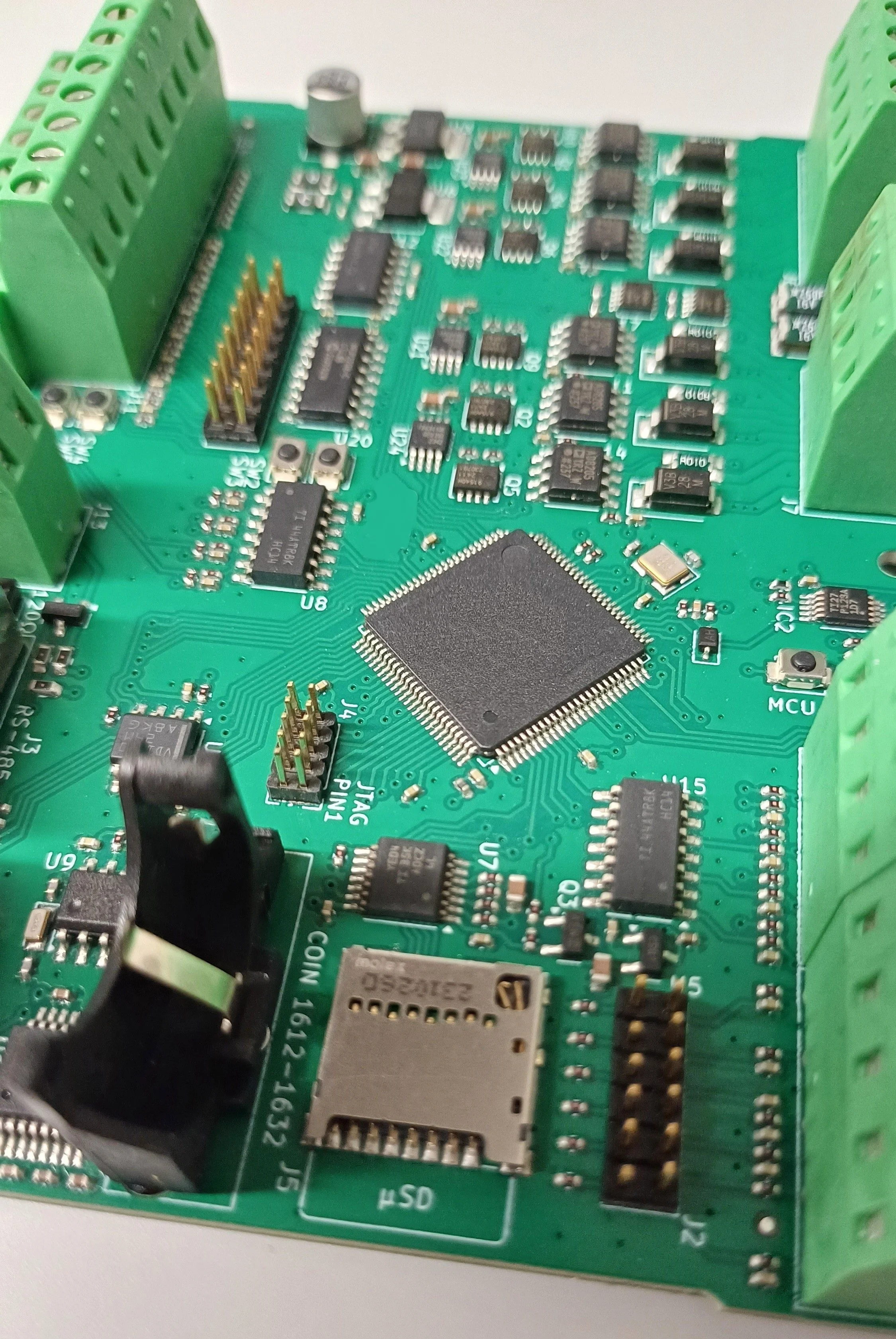
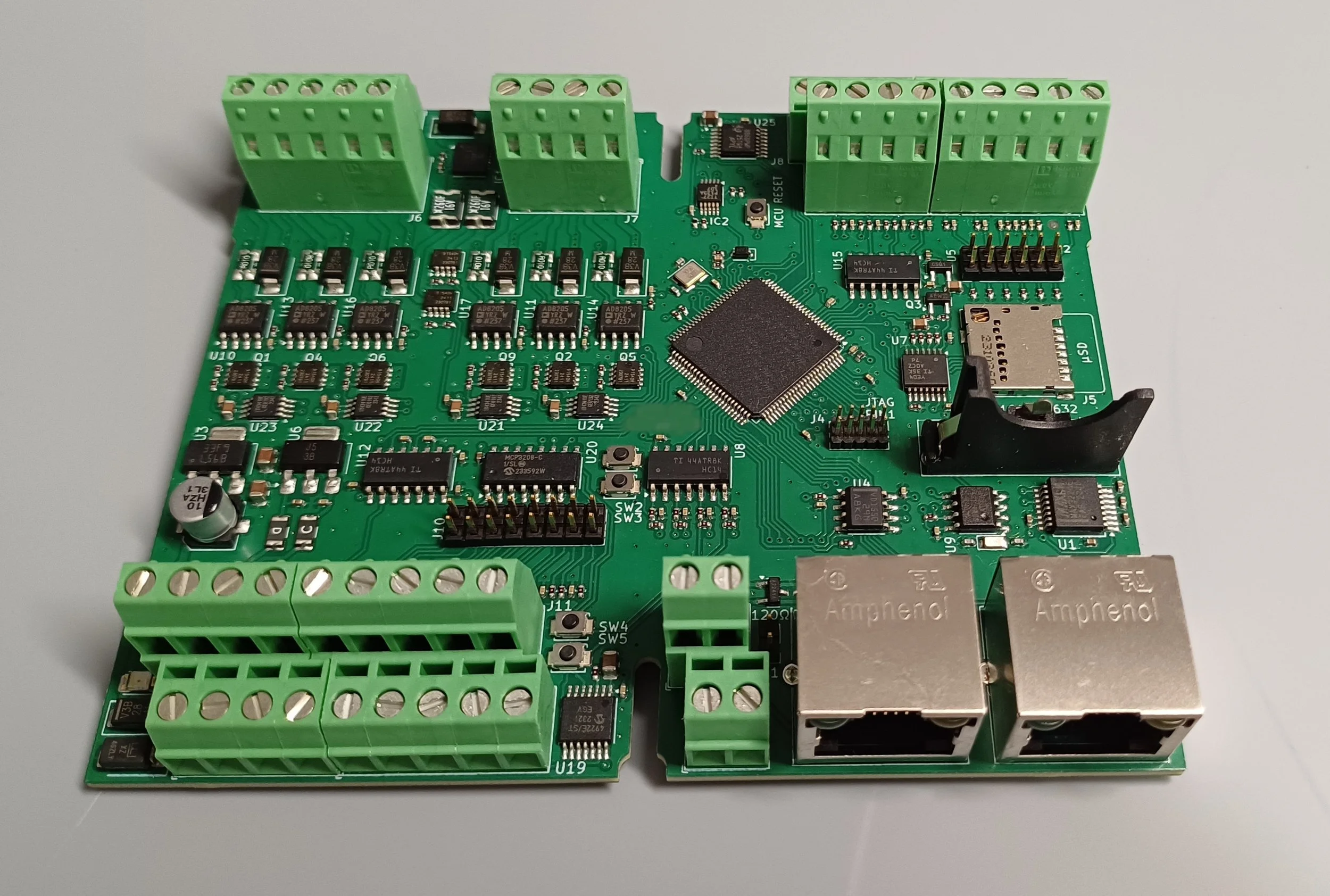
The controller interfaces with a broad range of analog and digital sensors, including pressure transducers, flow meters, and load cells, to enable closed-loop control of complex hydraulic systems. It communicates with other equipment using RS-232 and RS-485, and features onboard data logging via SD card and time-stamped records via a real-time clock; ideal for long-duration testing and reporting.
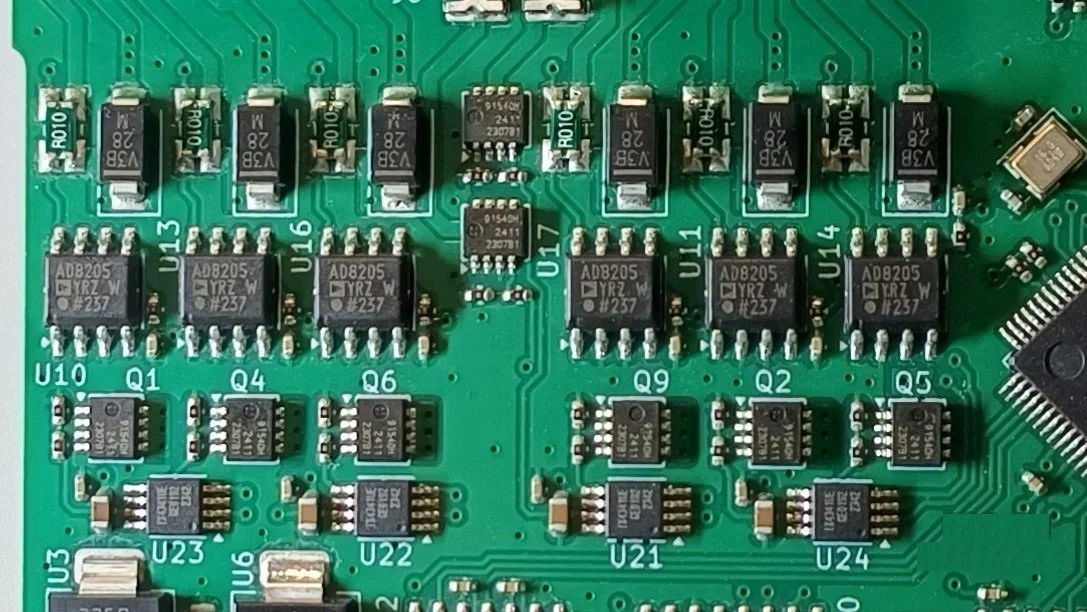
At the core of the system are six high-power, low-side drives with integrated current sensing and closed-loop feedback, allowing fine control of solenoid valves and actuators. These are supported by an additional two high-power non-sensing drives and eight low-power low-side outputs, all managed in real time by the onboard embedded firmware. The controller also includes 16 digital inputs and 8 analog inputs with selectable voltage ranges, providing broad compatibility with standard industrial sensors.
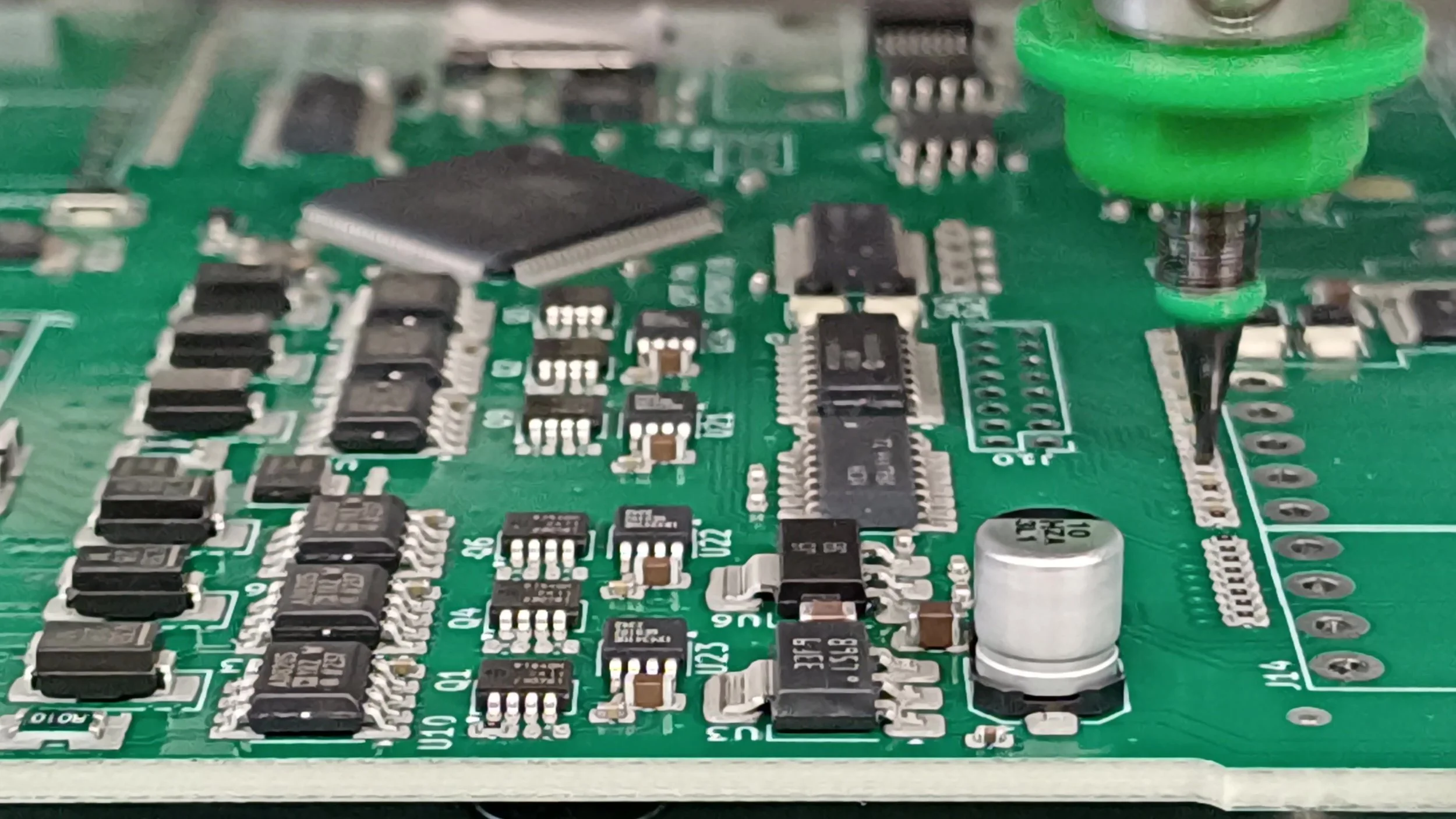
Our staff handled the full development lifecycle, including hardware design, PCB assembly, firmware development, mechanical integration, and ongoing development support. The controller is housed in a DIN rail-compatible enclosure, operates across a wide voltage input range, and includes robust protection against industrial transients, reverse polarity, and surge conditions, ensuring reliable long-term operation in harsh environments.
The design balanced performance, flexibility, and cost in a way not achievable with off-the-shelf PLCs. The design delivers significantly more compute capability than PLCs at a similar price point, while supporting a highly tailored I/O configuration. We continue to evolve the firmware as customer requirements develop, and the platform is easily adaptable for future variants; supporting different communication protocols (e.g. CAN, Ethernet, Modbus), I/O arrangements, or mechanical enclosures. This know-how lays an ideal foundation for other test and automation systems that demand tight integration and application-specific functionality.
Typical Applications
Control platforms such as these are suitable for a wide range of industrial machinery and automation systems, particularly where conventional PLCs fall short in flexibility, speed, or compute power. Example applications include:
Hydraulic Test Systems – controlling and monitoring pressure, flow, and force with high-speed feedback, sequencing, and real-time pass/fail detection.
Valve Characterisation Rigs – automated testing of hydraulic valve performance across varying pressure and flow regimes.
Multi-Actuator Control Systems – managing a large number of hydraulic or electromechanical actuators in parallel.
Sensor-Heavy Automation – interfacing with a broad array of analog and digital sensors for process control, testing, or data acquisition.
With deterministic real-time performance, robust I/O, and adaptable firmware, the controller was an ideal fit for the application requiring precise closed-loop control, high-channel-count actuation, or flexible sensor integration.